

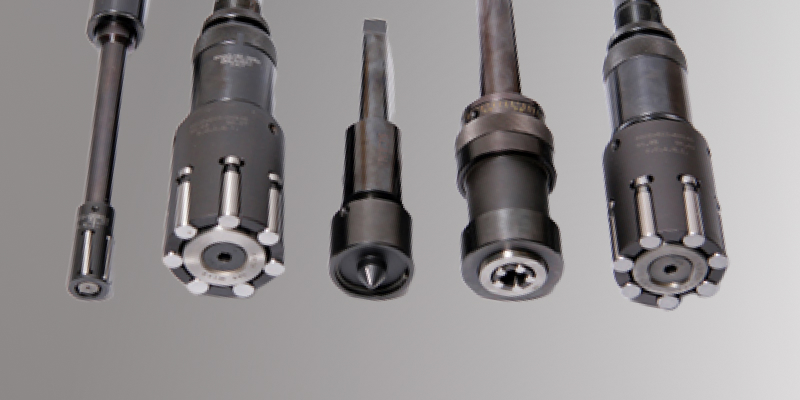
Unlike cold rolling, which generally produces large sectional changes, roller burnishing involves cold-working on the surface of the workpiece to improve surface structure.
In the burnishing process, the pressure generated by the rolls exceeds the yield point of the softer piece part surface at the point of contact. The result is a small plastic deformation of the surface structure of the piece part.
Since all machined surfaces consist of a series of peaks and valleys of irregular height and spacing, the plastic deformation created by roller burnishing is a displacement of the material in the peaks which cold flows under pressure into the valleys. In the process, tool marks and irregularities are rolled out. The result is a mirror like finish with a tough, work-hardened, wear and corrosion resistant surface.
Improved metallurgical properties
Burnishing cold works the metal of a machined part. Tool marks are rolled out. Grain structure is condensed and refined, and the compacted surface is smoother, harder and longer wearing than ground or honed surfaces.
The rolling action also greatly reduces surface porosity and scratches which could hold reactive substances or contaminants. As a result, the corrosion resistance of burnished surfaces is higher than the open surfaces produced by grinding or honing.
Depending on the type of material being burnished, surface hardness can be increased by as much as 10 points Rockwell C. This increase often eliminates the need for heat treatment as a means of improving wear resistance.
Another metallurgical improvement stems from induced residual compressive stresses in the surface of the part as a result of plastic deformation in the roller burnishing operation. These compressive stresses greatly increase the strength properties and fatigue life of the part, because any forces on the part must overcome these residual stresses, as well as the tensile strength of the materials, before fatigue conditions occur.
Improved surface finish
Roller burnishing imparts a high finish to any machinable metal. Surfaces that are bored, reamed or turned to 125 micro inches or more can be finished to 4 micro inch CLA or less in one pass at feed rates of 125 to 300 mm/min.
Roller burnishing replaces grinding, honing, lapping and other expensive secondary operations.